Microsoft Word grammar checker FAIL: “A climatology”
June 11, 2013 by Prof. David M. Schultz
Filed under Blog, Featured, Writing
Have you every seen that the automatic grammar checker in Microsoft Word flags “a climatology” as incorrect? I checked that “a climatological study” does not trigger the green underline, nor does “climatology” without the article “a”. Maybe it is some kind of check to see if someone says “a biology” not followed by a noun […]
An example of why hyphens are necessary
March 14, 2013 by Prof. David M. Schultz
Filed under Blog, Featured, Writing
The following is an excerpt from an email sent to staff at the University of Manchester. As part of the University’s commitment to creating change in gender equality across the University we are running a half day unconscious bias training session focussed on recruitment and promotion. The following is how it should have been punctuated […]
Wanted: Copyeditor. Inquire with God.
December 9, 2012 by Prof. David M. Schultz
Filed under Blog, Featured, Humor
(From slate.com)
What are your pet peeves?
July 5, 2010 by Prof. David M. Schultz
Filed under Blog, Featured, Posters, Potpourri, Presentations, Reviewing, Writing
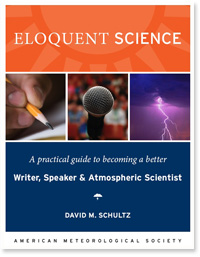
Appendix B: Commonly Misused Scientific Words and Expressions of Eloquent Science was inspired by a list of incorrect science expressions and annoyances maintained by Chuck Doswell. Many of Chuck’s pet peeves are included in Appendix B. I also surveyed my friends and colleagues about their pet peeves and included many of them in Appendix B. […]
Proper spellings of atmospheric science words
April 22, 2010 by Prof. David M. Schultz
Filed under Blog, Posters, Potpourri, Presentations, Resources, Reviewing, Writing
Did you know that shortwave radiation is not hyphenated, but short-wave trough is? Did you know that air mass is two words when used as a noun, but one word when used as an adjective (e.g., airmass modification)? If you are ever wondering how scientific words are spelled or used, the American Meteorological Society has […]
Bob The Angry Flower: It’s vs Its
April 2, 2010 by Prof. David M. Schultz
Filed under Blog, Humor, Popular, Potpourri, Uncategorized, Writing
Bob the Angry Flower speaks out against improper apostrophe use
February 25, 2010 by Prof. David M. Schultz
Filed under Blog, Humor, Popular, Potpourri, Uncategorized, Writing
Or, in color: Buy the poster here!
Did you know?
February 10, 2010 by Prof. David M. Schultz
Filed under Blog, Writing
That “Web” as in “Web page” is capitalized? That “chapter 5” and “section 3.2” are generally not capitalized, but “Figure 9” and “Table 1” are? That Microsoft Word flags “a climatology” and “a cloud” as grammatically incorrect? [I don’t know why. Does anyone out there?] That “native English–speaking colleague” uses an en dash, but “English-speaking […]
American versus British English
[DMS: This was a sidebar that I cut from the book. Even before I met and married my British–Australian wife, I had this sidebar in mind very early in the planning of the book.] Over 300 years of separation has led to discernible differences between English as practiced in the United States and English as […]