Free Writing and Publishing Online Workshop: 19–20 June 2024
April 12, 2024 Filed under Blog, News, Publishing, Uncategorized, Writing
Join Prof. David Schultz of the University of Manchester for a free 6-hour workshop on writing and publishing. During this two-day workshop, you will learn the process of peer review from an experienced and interdisciplinary author, reviewer, and editor. Get behind-the-scenes insight into how to better prepare your manuscript for submission, engage with the reviewers […]
How to be a more effective reviewer
As part of its 150th anniversary celebrations, Monthly Weather Review published my editorial “How to be a more effective reviewer”. The editorial has four sections: receiving the invitation, writing the review, after the initial review, and communicating with the editor. It provides guidance for first-time reviewers, but also experienced reviewers, to help make your reviews […]
Chinese translation of Eloquent Science now available
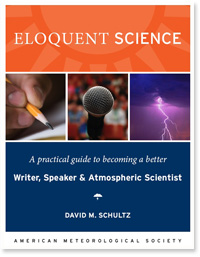
Thanks to the hard work of colleagues, there is a Chinese-language translation of Eloquent Science now available. A huge thank you to translators Haijiang Kong, Yan Han, Feimiao Zhao, M. Song, and Jidong Gao, who worked hard over many years to get this out. I am especially grateful to Haijiang who was the one who […]
Eloquent Science Workshops for Your Organization
June 24, 2020 Filed under Blog, Featured, News, Posters, Potpourri, Presentations, Publishing, Resources, Reviewing, Writing
I am delivering online and in-person workshops on scientific-communication skills designed specifically for your needs.
Errata from Eloquent Science
Here is a list of typos identified by the compositor of the book. These changes were not implemented at the time. p. 53, 1st graph: OK to change “formating” to “formatting”? p. 53, 3rd graph: OK to change “conciousness” to “consciousness”? p. 86, 3rd graph of section 9.8: OK to change “parenthethical” to “parenthetical”? […]
Step by Step from Writing to Publishing
I will be offering online training in scientific publishing through the Virtual Medical Academy. Called “Step by Step from Writing to Publishing”, the course will last for four two-hour sessions starting on 24 August. To sign up, visit the Virtual Medical Academy here. If you cannot make this session, I will likely conduct more in […]
Publishing Academic Papers Workshop
If you are at the University of Manchester, you can sign up to attend my day-long workshop called “Publishing Academic Papers”. It runs 5-6 times a year. The complete workshop schedule can be found here. This workshop covers: Why publish? How do I publish? How do peer review, editors, and journals work? Is my science […]
How to Get Your PhD Published: Workshop for Saudi Students Club in Manchester
Eloquent Science will be presenting a workshop at the Saudi Students Club of Manchester on Saturday 25 April 2015 at the Samuel Alexander Arts Theatre on “How to get your PhD published”. The workshop will last from 11 a.m. to about 4 p.m. (Image source: https://twitter.com/ksamcr/status/589967613645697025/photo/1)
Eloquent Science Workshop in Innsbruck
April 20, 2015 Filed under News
No April Fools this year! Eloquent Science was on hand at the Institute of Meteorology and Geophysics, University of Innsbruck, to present an afternoon workshop on scientific publishing and writing. Thanks to host Prof. Alexander Gohm!
I’ll be blogging the European Geosciences Union General Assembly
We’ll be blogging and tweeting (@EloquentScience) away at the 2014 European Geosciences Union General Assembly next week in Vienna, Austria. Get tips on how to improve your presentation. Find out who’s been naughty and who’s been nice. 😉 You can follow me and all the other bloggers and tweeters at http://geolog.egu.eu/general-assembly-blogroll/.