Are first-person pronouns acceptable in scientific writing?
 One of the most common questions I get is whether it is acceptable to use “we” or “I” in a scientific paper. “We” or “I” are first-person pronouns. Many professors tell their students not to use first-person pronouns in their writing, instead preferring a more passive tone. Instead of “We speculate that…”, these professors prefer “The authors speculate that…” or “It is speculated that….”
Interestingly, this rule seems to have originated with Francis Bacon to give scientific writing more objectivity.
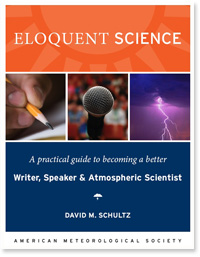
In Eloquent Science (pp. 76-77), I advocate that first-person pronouns are acceptable in limited contexts. Avoid their use in rote descriptions of your methodology (“We performed the assay…”). Instead, use them to communicate that an action or a decision that you performed affects the outcome of the research.
NO FIRST-PERSON PRONOUN: Given option A and option B, the authors chose option B to more accurately depict the location of the front.
FIRST-PERSON PRONOUN: Given option A and option B, we chose option B to more accurately depict the location of the front.
So, what do other authors think? I have over 30 books on scientific writing and have read numerous articles on this point. Here are some quotes from those who expressed their opinion on this matter and I was able to find from the index of the book or through a quick scan of the book.
“Because of this [avoiding first-person pronouns], the scientist commonly uses verbose (and imprecise) statements such as “It was found that” in preference to the short, unambiguous “I found.” Young scientists should renounce the false modesty of their predecessors. Do not be afraid to name the agent of the action in a sentence, even when it is “I” or “we.”” — How to Write and Publish a Scientific Paper by Day and Gastel, pp. 193-194
“Who is the universal ‘it’, the one who hides so bashfully, but does much thinking and assuming? “It is thought that… is a meaningless phrase and unnecessary exercise in modesty. The reader wants to know who did the thinking or assuming, the author, or some other expert.” — The Science Editor’s Soapbox by Lipton, p. 43
“I pulled 40 journals at random from one of my university’s technical library’s shelves…. To my surprise, in 32 out of the 40 journals, the authors indeed made liberal use of “I” and “we.” — Style for Students by Joe Schall, p. 63
“Einstein occasionally used the first person. He was not only a great scientist, but a great scientific writer. Feynman also used the first person on occasion, as did Curie, Darwin, Lyell, and Freud. As long as the emphasis remains on your work and not you, there is nothing wrong with judicious use of the first person.” — The Craft of Scientific Writing by Michael Alley, p. 107
“One of the most epochal papers in all of 20th-century science, Watson and Crick’s article defies nearly every major rule you are likely to find in manuals on scientific writing…. There is the frequent use of “we”…. This provides an immediate human presence, allowing for constant use of active voice. It also gives the impression that the authors are telling us their actual thought processes.” — The Chicago Guide to Communicating Science by Scott L. Montgomery, p. 18
“We believe in the value of a long tradition (which some deplore) arguing that it is inappropriate for the author of a scientific document to refer to himself or herself directly, in the first person…. There is no place for the subjectivity implicit in personal intrusion on the part of the one who conducted the research—especially since the section is explicitly labeled “Results”…. If first-person pronouns are appropriate anywhere in a dissertation, it would be in the Discussion section…because different people might indeed draw different inferences from a given set of facts.” — The Art of Scientific Writing by Ebel et al., p. 79.
[After arguing for two pages on clearly explaining why the first person should not be used…] “The first person singular is appropriate when the personal element is strong, for example, when taking a position in a controversy. But this tends to weaken the writer’s credibility. The writer usually wants to make clear that anyone considering the same evidence would take the same position. Using the third person helps to express the logical impersonal character and generality of an author’s position, whereas the first person makes it seem more like personal opinion.” —The Scientist’s Handbook for Writing Papers and Dissertations by Antoinette Wilkinson, p. 76.
So, I can find only one source on my bookshelf advocating against use of the first-person pronouns in all situations (Wilkinson). Even the Ebel et al. quote I largely agree with.
Thus, first-person pronouns in scientific writing are acceptable if used in a limited fashion and to enhance clarity.



Isn’t it telling that Ebel et al begin their argument against usage of the first person with the phrase ““We believe …”?
That is a reall good point, Kirk. Thanks for pointing that out!
This argument is approximately correct, but in my opinion off point. The use of first person should always be minimized in scientific writing, but not because it is unacceptable or even uncommon. It should be minimized because it is ineffective, and it is usually badly so. Specifically, the purpose of scientific writing is to create a convincing argument based on data collected during the evaluation of a hypothesis. This is basic scientific method. The strength of this argument depends on the data, not on the person who collected it. Using first person deemphasises the data, which weakens the argument and opens the door for subjective criticism to be used to rebut what should be objective data. For example, suppose I hypothesized that the sun always rises in the east, and I make daily observations over the course of a year to support that hypothesis. I could say, “I have shown that the sun always rises in the east”. A critic might respond by simply saying that I am crazy, and that I got it wrong. In other words, it can easily become an argument about “me”. However, if I said “Daily observations over the course of a year showed that the sun always rises in the east”, then any subsequent argument must rebut the data and not rebut “me”. Actually, I would never say this using either of those formulations. I would say, “Daily observations over the course of a year were consistent with the hypothesis that the sun always rises in the east.” This is basic scientific expository writing.
Finally, if one of my students EVER wrote “it was found that …”, I would hit him or her over the head with a very large stick. That is just as bad as “I found that …”, and importantly, those are NOT the only two options. The correct way to say this in scientific writing is, “the data showed that …”.
Hi Bill,
In general, I agree with you. We should omit ourselves from our science to emphasize what the data demonstrate.
My only qualification is that, as scientists, the collection, observation, and interpretation of data is difficult to disconnect from its human aspects. Being a human endeavor, science is necessarily affected by the humans themselves who do the work.
Thanks for your comment!
Dave
i could not understand why 1st person I is used with plural verb
Hi irfan,
Not sure that I completely understand your question, but grammatically “I” should only be used with a singular verb. If you use “I” in scientific writing, only do so with single-authored papers.
Does that answer your question?
Dave
why do we use ‘have’ with ‘i’ pronoun?
HI Irfan,
I wouldn’t view it as “I” goes with the plural verb “have”, but that “have” can be used with a number of different persons, regardless of whether it is singular or plural.
First person singular: “I have”
Second person singular: “You have”
Third person singular: “He/She/It has”
First person plural: “We have”
Second person plural: “All of you have”
Third person plural: “They have”
I know it perhaps doesn’t make sense, but that is the way English works.
I hope that helps.
Dave
I think there are a few cases where personal pronouns would be acceptable. If you are introducing a new section in a thesis or even an article, you might want to say “we begin with a description of the data in section 2” etc, rather than the cumbersome “this paper will begin with …”. Also in discussions of future work, it would make sense to say “we intend to explore X, Y and Z”.
I loved reading this, my Prof. and I were debating about this. He wants me to say “I analyzed” and I want to say “problem notification database analysed revealed that…”
I’m writing a paper for a conference. I wonder if I can defy a Professor in Korea:)
I disagree that writing in the 3rd person makes writing more objective. I also disagree that it “opens the door for subjective criticism to be used to rebut what should be objective data”. In fact, using the 3rd person obstructs reality. There are people behind the research who both make mistakes and do great things. It is no less true for science than it is for other subjects that 3rd person obstructs the author of an action and makes the idea being conveyed less clear. I find it odd that scientific writing guides instruct authors to BOTH use active voice AND use only the 3rd person. It is impossible to do both. Active voice means that there is a subject, a strong verb (not a version of the verb “to be”) and an object. When I say “The solution was mixed”, it is BOTH 3rd person and passive voice. The only way to construct that sentence without passive voice is to say “We mixed the solution”. Honestly, after spending most of the first part of my life in English classes and then transitioning to science, I find most scientific writing an abomonination.
Hi Kathleen,
I think it is great that you have had your feet in both English and science. For many of us who have struggled as writers, those people are great role models to aspire to.
An anecdote: my wife’s research student turned in a brief report on his work to date. She was showing me how well written his work was, really pretty advanced for an undergrad physics student. Later, she found out that he was trying to decide between majoring in physics and majoring in English.
Dave
Hi David. Thanks very much for your tips. Very interesting article. Did you just tweet that you should keep “I” and “We” out of the abstract? I am translating a psychology article from Spanish into English, and I’ve come up against an unwieldly sentence (the very last one in the abstract) that basically wants to say “We propose a number of strategies for improving the impact of the psychological treatments[…]” Would you say it’s a no-no? I tend to avoid personal pronouns in academic articles as much as poss, but it just sounds like the most natural option in this case. Perhaps I could put, “This article proposes a number of treatments…”? Strictly speaking it’s not the article that’s doing the proposing, obviously. I’d be very grateful to have your opinion. Thanks a lot. Best regards. Louisa
Yes, it’s difficult. How about going passive? “A number of treatments are proposed….”?
The comments against using first person, which are rampant in science education, are silly. Go read Nature or Science. I believe Kathleen makes a fantastic point.
Just happened across this blog while searching for something else, and procrastination rules, ok?
My pet hate is lecturers who uncritically criticise students for using the third person. Close behind is institutional guidance/insistence on third person ‘scientific writing’. Both are hugely ironic, the first because it is typically uncritical and purely traditional (we are employed to teach others to be critical and challenge tradition), the second because there is so little empirical evidence to suggest that the scientific method is third person.
I very much appreciated Bill Lott’s response because a) it was critical and b) it discussed the issue of good and bad writing as opposed to first and third person. However I would still suggest that the way he would report his exemplar data is all but first person:
“Daily observations over the course of a year were consistent with the hypothesis that the sun always rises in the east.”
Who did the observations if not the first person? All that is missing is My or Our at the beginning of the sentence and hey presto
Another facet of writing is that it disappears if not frequently watered and tended to.
Hi
Even though this is an old article, I’d like to add my 2c to the thread.
I think the use of the 3rd person is pompous, verbose and obtuse – it uses many words to say the same thing in a flowery way.
“It is the opinion of the author that” as opposed to “I think that”
Anybody reading the article knows that it’s written by a person / persons who did the research on the topic, who are either presenting their findings or opinion. The whole 3rd person thing seems to be a game, and I for one, HATE writing about myself in the 3rd person.
That being said, it seems to be the convention that the 3rd person is used, and I probably will write my paper in the 3rd person anyway, just to not rock the boat.
But I wish that the pomposity would stop and we would get more advocates for writing in plain English.
-A.
Hi, i was wondering… can “We” be said in a scientific school report?
Depends on the context, I guess. I would follow the same advice as above.
Dave
Thanks for all the tips. Don’t forget that in the future historians are going to want to know who did what and when. Scientists may not think it important, but historians will (especially if it is a significant contribution). Furthermore, by not revealing particulars regarding individual contributions opens the door for many scientists to falsify the historical record in their favor (I have experienced this first hand in a recent publication).
i think it is soo weird to use first person in reports…….third persons will be more effective when used and that will give a clear explanations to the audience
Even Nature journals are encouraging “we” in the manuscript.
“Nature journals prefer authors to write in the active voice (“we performed the experiment…”) as experience has shown that readers find concepts and results to be conveyed more clearly if written directly.”
https://www.nature.com/authors/author_resources/how_write.html