More on plain writing in the government
January 9, 2014 by Prof. David M. Schultz
Filed under Blog, Featured, Writing
Regular reader Brian Curran sends us this link on the Plain Writing Act and the results thereof, following up on earlier discussions of clear language in government writing. http://www.washingtonpost.com/blogs/federal-eye/wp/2013/11/19/plain-writing-in-government-agencies-plainly-speaking-arent-there-yet/ As the report card from the Center for Plain Language shows, NOAA gets a D for “Plain Writing”, although which documents were used was not stated […]
Speaking and writing so your audience understands you
August 10, 2013 by Prof. David M. Schultz
Filed under Blog, Featured, Writing
Brian Curran forwarded me this article about how to communicate with the public in active voice using straightforward, easy-to-understand language. Reading this article took me back to my time in Finland a few years ago. I loved to use colorful language and turns of phrases when I lived in the U.S. Then, in Finland, I […]
Junk the Jargon Interview on Public Engagement
June 14, 2013 by Prof. David M. Schultz
Filed under Blog, Featured, Potpourri, Presentations, Uncategorized
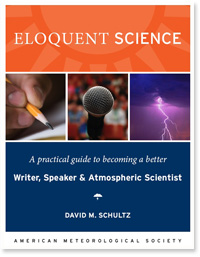
An oldie, but goodie. Here is an interview (Junkcast) I did for the University of Manchester Junk the Jargon competition. I talk about my own experiences good and bad with public engagement, tips for connecting with the audience, and the origins of Eloquent Science.
“Utilize” versus “Use”
December 18, 2012 by Prof. David M. Schultz
Filed under Blog, Featured, Uncategorized, Writing
From The Telegraph (sent to me by Jamie Gilmour): When the American writer David Foster Wallace died four years ago, he left behind the following fragments: notes towards a dictionary all of his own. Utilize A noxious puff-word. Since it does nothing that good old use doesn’t do, its extra letters and syllables don’t make […]
“Cold” equivalent potential temperature?
June 1, 2012 by Prof. David M. Schultz
Filed under Blog, Featured, Writing
As scientists, we need to be precise in our writing. Evgeni Fedorovich at the University of Oklahoma has tried to keep me honest about writing about “cold temperatures”. Know that the air can be “cold” or “warm”, but temperatures are “high” or “low.” I want to take this argument one step further. It makes no […]
How important is it to use “important” in your writing?
August 20, 2011 by Prof. David M. Schultz
Filed under Blog, Featured, Uncategorized, Writing
Have you read an article where the author talks about “an important process” or “the important role of another process”? Do these sort of platitudes go in one of your ears and out the other? Are you convinced by the author’s use of the word “important” that it truly is an important process? Or, do […]
Problems with the term “overrunning”
August 15, 2011 by Prof. David M. Schultz
Filed under Blog, Featured, Uncategorized, Writing
Several authors have criticized the use of the term overrunning to represent warm-frontal lifting here and here. I don’t need to add anything to those Web pages, but I do want to point out that the definition provided in the American Meteorological Society’s Glossary of Meteorology is wrong and ambiguous. overrunning—A condition existing when an […]
Is it in your nature to use “nature” in your scientific writing?
June 26, 2011 by Prof. David M. Schultz
Filed under Blog, Featured, Writing
Some authors have a habit of using the word “nature” commonly in their writing. I suspect that they don’t even think about it. It just seems, well, natural. In fact, the word is empty of meaning in many contexts. “cumuliform nature”: “the cauliflower-like visual appearance of convective clouds” “nature of the convection”: What do you […]
Dump the tilde
May 21, 2011 by Prof. David M. Schultz
Filed under Blog, Featured, Writing
I am an Assistant Editor at the Electronic Journal of Severe Storms Meteorology. As we have no paid staff, we depend upon authors to send us manuscripts that are near-ready to publish. The rest of the work we do ourselves, including much of the layout, technical and copy editing, and Web pages. For all that, […]
Take the Pledge: I Won’t Use Map-room Jargon!
April 20, 2011 by Prof. David M. Schultz
Filed under Blog, Featured, Posters, Presentations, Reviewing, Writing
If you regularly attend discussions in the weather-map room, subscribe to weather or storm-chaser discussion lists, or have reviewed articles for Weather, Monthly Weather Review, National Weather Digest, or Weather and Forecasting, then you have been exposed to it. Map-room jargon. Often the speakers of map-room jargon don’t even know what they are doing. (I […]