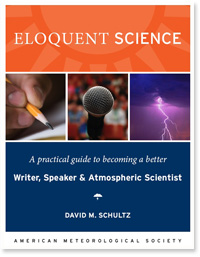
Recent Tweets Love Eloquent Science!
February 27, 2014 by Prof. David M. Schultz
Filed under Blog, Featured, News, Reviews
Interview with Scientia Crastina
November 11, 2013 by Prof. David M. Schultz
Filed under Blog, Featured, News, Potpourri
I did this great interview with Olle Bergman who runs the web page Scientia Crastina, which bills itself as “communication skills for the scientists of tomorrow”. Thanks, Olle! Readers, I hope you enjoy the interview. I had fun answering the questions that Olle posed for me!
Eloquent Science: Chapter 11 Figures
I received a request from a professor who uses Eloquent Science in the classroom. He wanted the figures from Chapter 11: Figures and Tables, so that he could adapt them into his own presentations. In response to that request, here they are, in a single PowerPoint file: Eloquent Science: Figures from Chapter 11
Junk the Jargon Interview on Public Engagement
June 14, 2013 by Prof. David M. Schultz
Filed under Blog, Featured, Potpourri, Presentations, Uncategorized
An oldie, but goodie. Here is an interview (Junkcast) I did for the University of Manchester Junk the Jargon competition. I talk about my own experiences good and bad with public engagement, tips for connecting with the audience, and the origins of Eloquent Science.
New: Eloquent Science Twitter now active
May 29, 2013 by Prof. David M. Schultz
Filed under Blog, Featured, News, Potpourri
Stop by and see what is going on at https://twitter.com/EloquentScience
Eloquent Science eBook and PDF chapters
February 26, 2013 by Prof. David M. Schultz
Filed under Blog, Excerpts, Featured, News
For those who want a digital copy of Eloquent Science, the book is now available through Springer for immediate PDF download (no copy protection, watermarked). The price (as of 26 February 2013) is £22.99 / $39.95 / €29.74. If you are at an educational institution, your library may have purchased the rights to the whole […]
Coming soon: eBook of Eloquent Science!
September 22, 2012 by Prof. David M. Schultz
Filed under Blog, Featured, News
The American Meteorological Society is close to offering eBooks of some of its titles. This means that Eloquent Science will soon be offered in electronic format. Watch this space!
New Review of Eloquent Science in Elements
April 8, 2012 by Prof. David M. Schultz
Filed under Blog, Featured, News
Elements, an international magazine of mineralology, geochemistry, and petrology, with a circulation of over 15,000 scientists has just published a full-age review of Eloquent Science by Pierrette Tremblay, Managing Editor. Among the writing guides I have read (and there have been several), I would rate this book at the top. It would be well suited […]
How to add line numbers to your manuscript
The journals of the American Meteorological Society now require line numbers in submitted manuscripts. How do you add such line numbers to your manuscript? From p. 374 of Eloquent Science: A Practical Guide to Becoming a Better Writer, Speaker and Scientist: “Final Checks of Your Manuscript,” “Lines numbered in margin”: You may wish to add […]
Eloquent Science 4-GB flashdrives
I have these nifty Eloquent Science 4-GB flashdrives for sale. They cost £10/€15/$15 if you see me in person, or add £3/€5/$6 for postage. The drive comes preloaded with lots of great resources: • Excerpts and outtakes from Eloquent Science • 21 direct links to online resources • 61 articles specifically designed to help develop […]