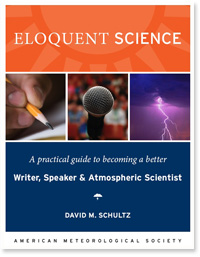
Eloquent Science Workshops for Your Organization
June 24, 2020 Filed under Blog, Featured, News, Posters, Potpourri, Presentations, Publishing, Resources, Reviewing, Writing
I am delivering online and in-person workshops on scientific-communication skills designed specifically for your needs.
Chapter 5: “The Motivation to Write”, plus Video: “Overcoming Barriers to Writing”
“Writing can be a struggle, or it can be fun. Most likely it is both. The attitude with which we approach the writing project can determine its success. Lack of motivation and writer’s block can prevent us from beginning, continuing, completing, and enjoying writing projects. This chapter provides strategies for overcoming these obstacles to our […]
How to download a reference from AMS Journals Online
. 1. Go to an article, say http://journals.ametsoc.org/doi/abs/10.1175/MWR-D-16-0460.1 2. On the red bar, click on the download button (third icon from left). 3. This screen appears: http://journals.ametsoc.org/action/showCitFormats?doi=10.1175%2FMWR-D-16-0460.1 4. At the bottom, you can copy the text for the reference list, including the doi. Steenburgh, W.J. and L.S. Campbell, 2017: The OWLeS IOP2b Lake-Effect Snowstorm: Shoreline […]
“Improving Together: Better Science Writing Through Peer Learning”
How do you motivate early-career researchers to improve their communication skills? Mathew Stiller-Reeve from the Bjerknes Centre for Climate Research in Bergen, Norway, and colleagues reveal how they were able to develop their writing and communication skills through the development of the ClimateSnack project, described in this journal article in Hydrology and Earth System Sciences. […]
Book review: Science Research Writing for Non-Native Speakers of English
October 9, 2015 Filed under Blog, Featured, Publishing, Writing
When I wrote Eloquent Science, the most difficult chapter to write was the one for non-native English speakers. Growing up a native English speaker, I felt that I couldn’t offer much about how to help non-native speakers write better. But, I strongly felt that the book needed to say something to this audience. The books […]
Book review: Designing Science Presentations: A Visual Guide to Figures, Papers, Slides, Posters, and More
August 26, 2015 Filed under Blog, Featured, Posters, Potpourri, Presentations, Publishing, Reviewing, Uncategorized, Writing
Here is another in my series of reviews for books that I read a while ago and were sitting on my desk waiting for the time to write the review. This review is of Matt Carter’s Designing Science Presentations: A Visual Guide to Figures, Papers, Slides, Posters, and More. Outside of my own book, I’ve […]
Book Review: Trees, maps, and theorems: Effective communication for rational minds by Jean-luc Duomont
I got a copy of Jean-luc Doumont’s Trees, Maps, and Theorems Effective Communication for Rational Minds a long time ago, and read it almost immediately. I’ve been meaning to write a review for a long time. With the annual office clean before the new semester starts, this gives me a perfect opportunity to do so. […]
Responding to Reviewers: It’s the way you say it
August 3, 2015 Filed under Blog, Featured, Publishing, Reviewing, Writing
Nature Methods has a few nice links over on their page about responding to criticism before and after publication. The way you say it The dos and don’ts of communicating with editors and reviewers Here are some of the choice quotes from the first link that I related to, from my experience as an author […]
Why the first letter of your last name matters
Sent from frequent reader and commenter Jon Zeitler: https://agenda.weforum.org/2015/06/why-the-first-letter-of-your-surname-matters/ When individuals make choices from lists, does the list ordering matter? There may be a ‘primacy effect’, where individuals are biased towards selecting items earlier in the list. Conversely, there may be a ‘recency effect’, i.e. a tendency to select items towards the end of the […]
New resource for teaching students how to find, read, and use the literature
The UK Higher Education Academy just published our second report in the series How to Succeed at University in GEES Disciplines: Enhancing Student’s Information Literacy Skills. (GEES is Geography, Earth and Environmental Sciences.) I wrote this with coauthor Rich Waller at Keele University. Contents include finding and assessing scientific literature, critical reading, citing sources and […]