English Communication for Scientists
February 18, 2011 by Prof. David M. Schultz
Filed under Blog, Featured, Posters, Presentations, Resources, Writing
The journal Nature has on its Scitable page a link to an online book English Communication for Scientists by Dr. Jean-luc Doumont (that’s him on the right). I haven’t read through it all, but it seems to have mostly good advice, albeit a bit short. The online book has six units: Communicating as a Scientist […]
Is your “Outline” slide really needed?
February 18, 2011 by Prof. David M. Schultz
Filed under Blog, Featured, Presentations, Uncategorized
If you are giving a scientific talk at a conference (e.g., one that lasts 10 minutes), do you really need an outline slide? Do you really think the audience needs to know what the basic content of your scientific presentation is going to be? Even in longer talks, is such a slide really needed? When […]
Do you end with a ‘thank you’ or ‘questions?’ slide?
February 9, 2011 by Prof. David M. Schultz
Filed under Blog, Featured, Popular, Presentations
If you do, you are wasting a valuable opportunity to leave your audience with your take-home message. Of course, you should express your appreciation to your audience by thanking them for their attention, but I am not impressed by a speaker who thinks that a slide is the way to express such sincerity. Likewise, everyone […]
Take the Poll: Color Schemes in Presentations
December 28, 2010 by Prof. David M. Schultz
Filed under Blog, Featured, Presentations
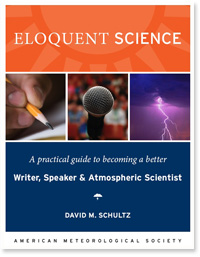
In Eloquent Science (p. 279), I made the argument that light-colored text on dark-colored backgrounds was preferable to dark-colored text on light-colored backgrounds for three reasons. 1. Red lasers (especially if the laser light is weak) may not show up well on white backgrounds. 2. Slides with white backgrounds lose contrast if the room is […]
Edward Tufte and kittens
April 8, 2010 by Prof. David M. Schultz
Filed under Blog, Featured, Humor, Potpourri, Presentations
Thanks to Mark Goetz!
Prof. Rob Fovell (UCLA) on PowerPoint and Teaching
March 20, 2010 by Prof. David M. Schultz
Filed under Blog, Featured, Potpourri, Presentations
I do not use PowerPoint in class. PowerPoint is virtually a necessity for scientific talks, but I think they often hurt classroom lectures. They lock me into a particular order, and they tend to make me go through material too fast. My handwriting is poor, but I write in class so I don’t go too […]
Recommended Reading
January 29, 2010 by Prof. David M. Schultz
Filed under Blog, Excerpts, Featured, Posters, Potpourri, Presentations, Resources, Reviewing, Writing
Previously, I provided three items of essential reading. Here are other books that I highly recommend for improving your scientific communication skills. HIGHLY RECOMMENDED READING ON WRITING Cook (1986): Line by Line: How to Edit Your Own Writing delivers a thorough accounting of the editing process. The book deals mainly with sentence-level revisions and contains […]
Can you answer “yes” to every question for every slide in your presentation?
January 28, 2010 by Prof. David M. Schultz
Filed under Blog
From the NERC booklet Communicating Your Ideas. More about this booklet here.
Quotes from Don’t Be Such a Scientist
January 19, 2010 by Prof. David M. Schultz
Filed under Blog, Presentations, Writing
On the recommendation of Prof. David Karoly, I bought Randy Olson’s Don’t Be Such a Scientist: Talking Substance in an Age of Style. I highly recommend this book for those who want to make their science more accessible to others (both scientists and nonscientists). Olson breaks down his observations of how best to communicate to […]
Talking Science: The Elusive Art of the Science Talk
January 18, 2010 by Prof. David M. Schultz
Filed under Blog, Presentations, Resources
This 18-minute video called “Talking Science: The Elusive Art of the Science Talk” was produced by the USC Wrigley Institute for Environmental Studies and the USC Annenberg School for Communication. It was made by Randy Olsen, author of Don’t Be Such a Scientist: Talking Substance in an Age of Style. I was informed of Olsen’s […]