Thoughts about Clarke’s “Ethics of Science Communication on the Web”
September 22, 2012 Filed under Blog, Featured, Publishing, Uncategorized
My friend Jim reminded me about an article “Ethics of Science Communication on the Web” by Maxine Clarke of the Nature Publishing Group in Ethics in Science and Environmental Politics. I might have seen this paper before, but Jim’s reminder and me taking a look at it again strikes me as a little ironic. Don’t […]
How to choose a scientific problem and nurturing young scientists
April 1, 2012 Filed under Blog, Featured, Resources, Uncategorized
I discovered the following article a while ago, yet only have gotten around to writing about it now. Alon, U., 2009: How to choose a good scientific problem. Molecular Cell, 35, 726-728. [PDF] [HTML] Why the paper resonated with me is that it brought me back to choosing my research topic for my PhD. I […]
Review: “Writing Science” by Joshua Schimel
March 21, 2012 Filed under Blog, Featured, Resources, Uncategorized, Writing
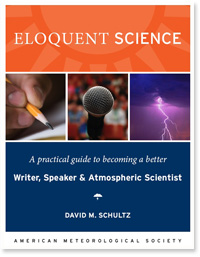
I just finished reading a new book Writing Science: How to Write Papers That Get Cited and Proposals That Get Funded by Prof. Joshua Schimel, in the Department of Ecology, Evolution, and Marine Biology at UC Santa Barbara. Schimel’s book is the perfect companion to Eloquent Science. Whereas Eloquent Science provides guidance about how to […]
More on British and American English
March 11, 2012 Filed under Blog, Featured, Resources, Uncategorized, Writing
In a previous post, I had given a set of the more common rules for American and British English differences. Since then, I have received comments and emails asking me about how to submit to a journal that uses a form of English different from the one that you use. I can speak for myself […]
Petterssen, Palmén and Newton, Carlson, and Lackmann
September 7, 2011 Filed under Blog, Featured, News, Resources, Uncategorized
I am honored to have seen page proofs of Gary Lackmann’s new book Midlatitude Synoptic Meteorology: Dynamics, Analysis, and Forecasting to be published later this year by the American Meteorological Society. For this book, Gary goes back to the original meaning of the word synoptic (“forming a summary or synopsis”). Twelve chapters summarize and synthesize […]
How important is it to use “important” in your writing?
August 20, 2011 Filed under Blog, Featured, Uncategorized, Writing
Have you read an article where the author talks about “an important process” or “the important role of another process”? Do these sort of platitudes go in one of your ears and out the other? Are you convinced by the author’s use of the word “important” that it truly is an important process? Or, do […]
Problems with the term “overrunning”
August 15, 2011 Filed under Blog, Featured, Uncategorized, Writing
Several authors have criticized the use of the term overrunning to represent warm-frontal lifting here and here. I don’t need to add anything to those Web pages, but I do want to point out that the definition provided in the American Meteorological Society’s Glossary of Meteorology is wrong and ambiguous. overrunning—A condition existing when an […]
The proliferation of scientific literature
June 14, 2011 Filed under Blog, Uncategorized
For some perspective on my previous post about the growing number of online open-access journals, I was reminded today of an article by Brian Vickery (1999) describing the development and explosion of the scientific literature during the 1900s. That article discussed the fact that many scientists were already overwhelmed by the huge amount of scientific […]
Potential Temperature: Warm and Cold?
June 14, 2011 Filed under Blog, Potpourri, Uncategorized, Writing
Does it make sense to talk about air with high values of potential temperature or equivalent potential temperature as warm or cold? I don’t think so, so I recommend talking about “air with higher or lower potential temperature” instead. Although it is wordier than warm or cold, the meaning is precise.
When should you cite a paper?
March 12, 2011 Filed under Blog, Featured, Resources, Uncategorized, Writing
3 month thesis by James Hayton has a free guide that you can sign up to receive called “The Short Guide to Writing Fast.” Inside I found this concise quote about when you should cite a paper (p. 20): You should only cite a paper… • To support one of your arguments • To provide […]