Does “play a role” still play a role in your writing?

Your role is to improve your communication to your audience. Source: www.cgsinc.com
Consider these sentences, paraphrased from real journal articles.
❌ Rising motion is hypothesized to play a role in the transport of moisture to the tropopause.
❌ Insolation forcing plays a primary role in determining equatorial seasonality.
❌ The Rocky Mountains play a key role in controlling the land and sea-surface temperatures in high latitudes.
❌ Temperature plays a secondary role in seasonal runoff in the mountains of the West.
❌ Fluctuations in a cloud’s updraft depth/volume plays a pivotal role in understanding where lightning is initiated.
In common across all these quotes is the phrase “plays a role”. Although there is nothing wrong grammatically with these sentences, the use of this phrase may signal a number of weaknesses in science communication. I was first alerted to this concern by Lawrence (2001), and I expand on it below.
This is a pervasive problem in atmospheric science. A search through the American Meteorological Society Journals Online archive for “plays a role” in the body of the text reveals 7419 results, with 3 even using this phrase in the title of the article. Now, as we discuss below, not all examples of “play a role” are necessarily bad, but I do believe a large fraction of them can be improved.
How to improve these examples
Consider the first example above. Rising motion (or more concisely, ascent) is transporting the water to the tropopause. Thus, this sentence can be written much more concisely and clearly:
✅ Ascending air transports water vapor to the tropopause.
In the second example, the seasons are caused by changes in incoming solar radiation (i.e., insolation). Duh. So, just write it that way.
✅ Equatorial seasonality is caused by changes in insolation.
In the third example, “play a key role” obscures the physical process that connects the Rockies to the temperatures. Is it a shorthand convention to avoid talking about the complicated process by which the connection happens? Is it because the authors recognize there is a linkage, but are unsure of the mechanism or cannot quantify it? Is the connection merely a correlation rather than a causation? In any case, this example could be improved by rewriting it in several ways.
If the mechanism is known, just write it that way.
✅ The Rocky Mountains force a quasistationary planetary wave pattern that deflects the jet and shifts storm tracks, thereby modulating high-latitude land and sea-surface temperatures.
Better yet, can you explain the mechanism and quantify it?
✅ In winter, stationary Rossby waves forced by the Rocky Mountains account for about 30% of the variance in high-latitude surface air temperature and cool the subpolar North Pacific sea-surface temperatures by about 1°C, via enhanced turbulent heat loss downstream.
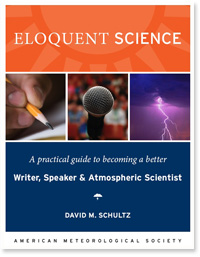
As I write in Eloquent Science (p. 215):
Atmospheric processes are often the result of multiple processes acting together. To claim that a weather phenomenon is “responsible for,” “plays a primary role in,” or “causes” would be to oversimplify the actual mechanisms. For example, deep moist convection requires three ingredients: lift, instability, and moisture. Therefore, claiming that a single factor such as the unstable environment “plays a key role” in the resulting convection would be to ignore the other two ingredients, which must be present as well.
Therefore, if other factors are also contributing:
✅ The Rocky Mountains contribute to high-latitude temperature variability by altering large-scale circulation, although the sea-surface temperature response is seasonally dependent and also modulated by sea-ice feedbacks.
If the uncertainty is intended:
✅ The Rocky Mountains contribute to high-latitude temperature variability by altering large-scale circulation, although the exact mechanism and the magnitude of this effect remain uncertain.
By now, you may be able to see the issues with the last two examples and suggest improvements.
Better choices
You can avoid “play a role” by choosing verbs that better describe the process, such as influence, cause, control, affect, determine, or contribute.
By thinking about what you want to convey to the reader (and we generally do want to convey more clear and precise information), we can better communicate the scientific results and present a more vivid depiction of the processes involved than the vague “plays a role”.
So, whatever meaning you implied by something “playing a [insert adjective here] role”, you can improve your writing, making it more precise, more clear, or more concise through careful revision.
REFERENCE
Lawrence, P. A., 2001. Science or alchemy?. Nature Reviews Genetics, 2(2), 139–142, https://doi.org/10.1038/35052571.