How do you get to Carnegie Hall? 10,000 Hours
Slate.com has had an interesting series of articles (two of them are here and here) about the creativity originating from working in pairs: think Lennon and McCartney, Joel and Ethan Cohen, Richards and Jagger. In the second installment, Joshua Wolf Shenk said about the two Beatles: The nature of John and Paul’s intimacy evolved over […]
10 Tips on How to Write Less Badly
I was recently in Norman, Oklahoma, to present an Eloquent Science workshop, hosted by J.J. Gourley of the NOAA/National Severe Storms Laboratory. It was a lively and enthusiastic group in attendance, and I thank everyone who participated, bought books, and talked to me afterward. It’s great to know that there’s such interest. Yesterday, J.J. sent […]
Reference list style guides
As an author, creating and double-checking reference lists in your manuscript are a hassle. Chances are if you make a mistake, a reader will go looking for that source and be stymied by a wrong year or incorrect page number. On top of the problems of accuracy, different journals require different formats for their reference […]
Where to publish case studies in meteorology
Dr. Alexander Keul of Salzburg University asked me whether any journals were publishing case studies in meteorology. What was interesting was that I had received another question or two along these lines recently. Seemed like an opportunity to blog. I would argue that there are two extremes of what one might call “case studies.” On […]
What are your pet peeves?
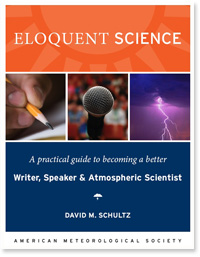
Appendix B: Commonly Misused Scientific Words and Expressions of Eloquent Science was inspired by a list of incorrect science expressions and annoyances maintained by Chuck Doswell. Many of Chuck’s pet peeves are included in Appendix B. I also surveyed my friends and colleagues about their pet peeves and included many of them in Appendix B. […]
If a tree falls in the forest…
This month’s issue of the Annals of Improbable Research answers the question of whether a tree falling in the forest will make a sound if no one is around to hear it. The answer is yes (Melchior 2010). Moreover, the bigger the tree, the louder the sound. What I like about this article is that […]
Positive and negative feedback in science: Scientists as social animals
At a recent meeting at the University of Manchester, the keynote speaker was Prof. Helen Gleeson OBE. She gave an informative and interesting history of her career and the lessons she has learned. One thing she said resonated with me (paraphrasing): “As a scientist, you get lots of rejections, but not a lot of supportive […]
How to Research and Write Effective Case Studies in Meteorology
If you write or review case studies, this open-access article at the Electronic Journal of Severe Storms Meteorology provides 16 tips about how to research and write an effective case study. Schultz, D. M., 2010: How to research and write effective case studies in meteorology. Electronic J. Severe Storms Meteor., 5 (2), 1-18.
Publishing the Same Work in Two Languages
In one of the workshops I was teaching, I was asked whether it was acceptable to publish the same article twice in two different languages. I was a bit stumped as to what to say. Keith Seitter, the Executive Director of the American Meteorological Society, was able to provide a great answer to this question. […]
Forecasters Forum
The journal Weather and Forecasting (a sister journal to Monthly Weather Review, the journal for which I serve as Chief Editor) has a department called Forecasters Forum. It is a department allowing anyone (not just forecasters) to hold “discussions of forecasting problems and solutions” (Burpee and Snellman 1986). In a Forecasters Forum article, authors are […]