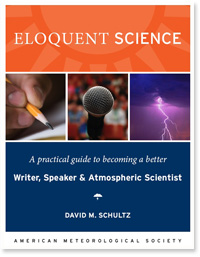
Advice to writers: Treat it like teaching
While helping a student write a particularly challenging chapter in his dissertation, it occurred to me that one piece of advice that may help him is to treat his writing like teaching. Imagine, if instead of communicating your science through a written report, you had to teach your ideas to students who had not seen […]
Why you need to read your page proofs carefully…
From http://www.theguardian.com/science/grrlscientist/2014/nov/12/scientific-schadenfreude:
Damn the tildes and full speed ahead!
Reader Matt Bunkers raised the issue of the tilde (~) in scientific writing. Some use it for “proportional to”. Others use it for “order of magnitude”. Still others use it for “approximately”. Given the wide variety of uses for the tilde, why not just write out what you mean? Doing so will make your writing […]
Announcing: Publiscize
Calling All Scientists! From Dr. Robert Seigel: In my “spare” time, I have been working on an exciting project that can revolutionize our science communication. I am starting a new initiative called Publiscize (www.publiscize.com) and its purpose is to increase scientists’ research visibility, encourage cross-field collaboration, educate the public, and showcase university departments, schools, and […]
Jim Steenburgh’s “Secrets of the Greatest Snow on Earth”
Hi friends, If you like winter weather, skiing, or just damn good writing, check out this book by my friend and colleague Prof. Jim Steenburgh. Jim is one of just a handful of the most conscientious and careful writers that I have worked with. Secrets of the Greatest Snow on Earth: Weather, Climate Change, and […]
Polar Vortex, Redux
December 16, 2014 Filed under Blog, Potpourri, Uncategorized
Lee Grenci has a lot to say about the polar vortex and its abuse in the media. https://www.e-education.psu.edu/worldofweather/node/2103
Use your middle initial. Appear smarter.
A coauthor on a paper and I ended up discussing whether scientists should use their middle initial on a paper. An article entitled “The impact of middle names: Middle name initials enhance evaluations of intellectual performance” in the European Journal of Social Psychology addresses this issue. The abstract reads: Middle name initials often appear in […]
How to respond to reviewers: When two reviewers say the same thing
My coauthors and I were talking about the responses to the reviewers that we were writing for a paper that was in peer review. Because two of the reviewers raised issues about the same item, my coauthor wrote a thoughtful response to Reviewer #1, then, in response to Reviewer #2, said basically, “See our response […]
“Conclusions and Discussion”? What should you call the last section of your paper?
Astute reader Colin Smith fired the following question my way: I find that many authors call their closing section “Conclusions and discussion”, rather than ‘Discussion and conclusions”. I prefer the latter because, to me, it is logical to first discuss your results in a wider context, and then draw conclusions. However, I also understand why […]
David Byrne: Inspiration for Good Science Writing
About a month ago, I had finished reading How Music Works by David Byrne (formerly of Talking Heads). I was always a big fan of the music of Talking Heads and Byrne, and I found his movie True Stories quirky. I am a huge musicophile, as well, and when I saw the book on the […]